Tool policies
A ToolBlock policy decides which tools the agent is allowed to call
and which it can't. In the dashboard these rules live under a policy
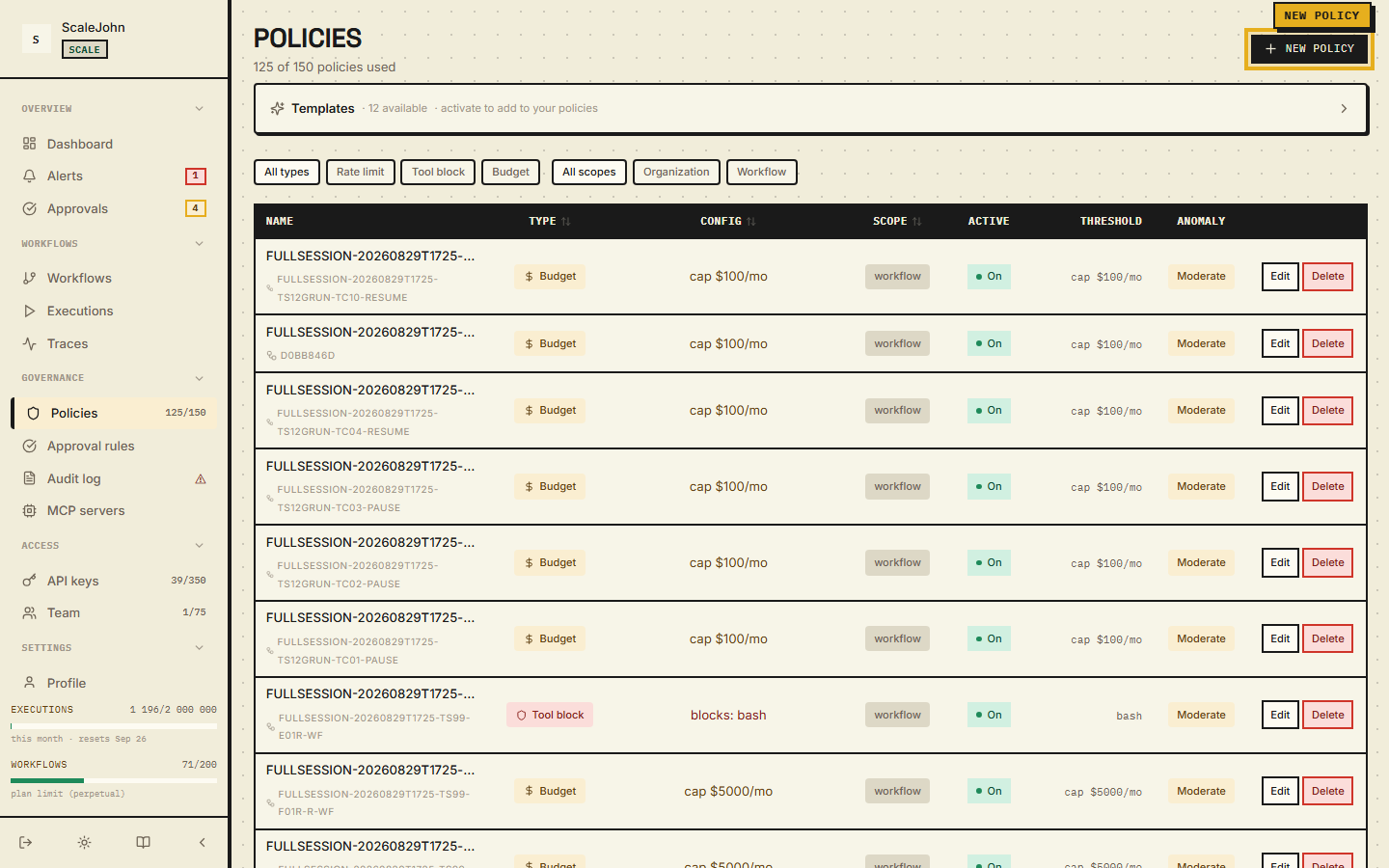
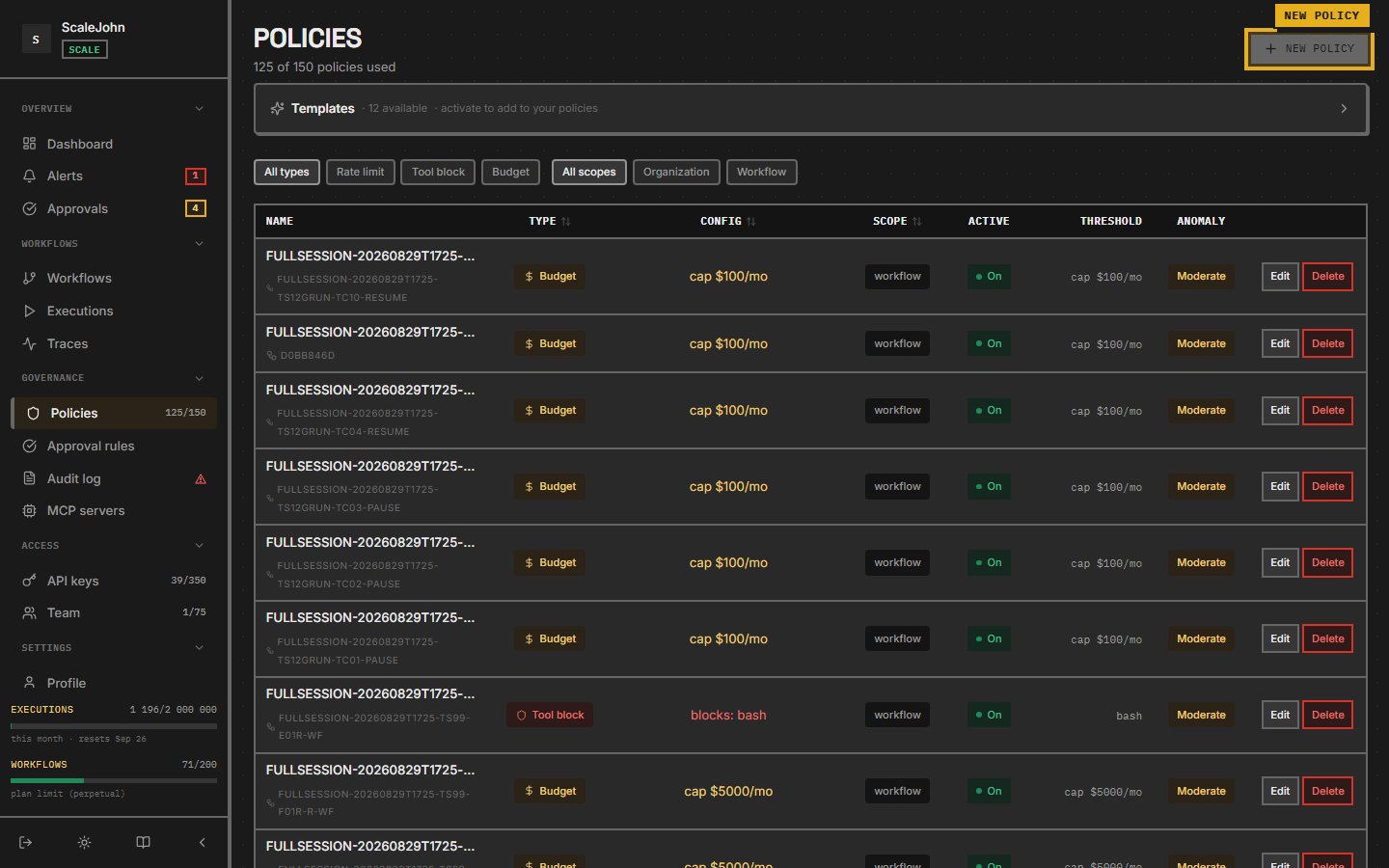
of type ToolBlock — see Policies for the general
overview. This page covers how to write the patterns inside the
policy.
Where you see it in the dashboard
When you create or edit a policy and pick ToolBlock as the
type, the dashboard shows a JSON editor for the tool_pattern,
blocked_tools, or tools array. The "Test pattern" preview at the
bottom lets you paste a tool name and see whether any pattern
matches — useful for debugging.
What a tool name looks like
The agent calls tools by name. The canonical tool name format:
| Type | Format | Example |
|---|---|---|
| Built-in tool | lowercase string | bash, file_write, execute_code |
| MCP tool | mcp://{server}/{tool} |
mcp://filesystem/read |
| Custom tool | custom:{name} |
custom:my_tool |
The policy matcher is name-based. The SDK sends the tool name to the
gate, the gate checks it against every active ToolBlock policy, and
the verdict comes back as allow, block, or require_approval.
How to write the patterns
Each entry in a ToolBlock policy is one of:
- Exact name —
"stripe.charge"blocks only that one tool. - Glob —
"send_*"blocks anything starting withsend_. *alone — blocks everything.
Each entry is capped at 4096 bytes. The cap exists because the matcher scans every pattern on every gate call — a 10 MB pattern would burn CPU on each call.
The matcher runs case-insensitively against the canonical tool name.
What a ToolBlock policy does
A ToolBlock policy blocks tool calls whose name matches one of
its patterns. There is no action = require_approval field on a
ToolBlock — for "I want a human to approve before this tool runs",
create an approval rule instead (see
Human approval). The two are separate rule
objects; ToolBlock and approval rules don't share a configuration
schema.
ToolBlock is always Hard: it never lets through, regardless of
the budget's enforcement_mode. See
Reliability matrix.
If the gate cannot evaluate the ToolBlock check (Redis or policy
cache unavailable), it fails closed — 403 TOOL_BLOCKED (SDK
error_code = "NR-T001"). The agent never runs an unverified
sensitive operation.
ToolBlock and approval rules are distinct rule objects — they don't share a configuration schema. A ToolBlock policy always blocks; to require human review first, use an approval rule instead.
A worked example
Suppose your agent has these tools: tavily_search, send_email,
db.write, db.drop, stripe.charge, read_file.
You want to:
- Allow read-only operations (
tavily_search,read_file) - Block destructive operations (
db.drop,stripe.charge) - Require approval for any outbound communication (
send_email) - Allow normal DB writes (
db.write) but blockdb.drop
Two ToolBlock policies and one approval rule:
The example below shows the request payload shape — what you POST to the dashboard / API. It's not the storage schema, just the public input format.
{
  "policies": [
    {
      "name": "Block destructive",
      "type": "ToolBlock",
      "scope": "Org",
      "config": {
        "tool_pattern": ["db.drop", "stripe.*"]
      }
    }
  ],
  "approval_rules": [
    {
      "name": "Outbound needs approval",
      "tool_patterns": ["send_email"],
      "action_label": "send email to customer",
      "expires_in_seconds": 300
    }
  ]
}
send_email now triggers the approval flow (a human clicks
Approve in the dashboard before the call goes through). db.drop
and stripe.charge are blocked outright. The two policies do not
interact — ToolBlock checks and approval-rule checks are independent
paths in the gate.
Validation at policy creation
The dashboard rejects invalid patterns at save time:
| Error | Cause | Fix |
|---|---|---|
400 bare_string_pattern |
"pattern": "send_*" instead of "pattern": ["send_*"] |
Always use an array, even for one entry |
400 pattern_too_long |
An entry longer than the per-pattern byte cap | Split into multiple patterns |
400 invalid_glob |
Contains control characters | Remove \n, \r, \t |
Plan gating
ToolBlock policies require the Custom Policies feature, which is
on Growth+ plans. Lite and Starter can have BudgetLimit and
RateLimit policies, but not ToolBlock.
On Lite / Starter, the dashboard shows ToolBlock policy creation greyed out with an "Upgrade" link.
How to debug a block you didn't expect
If your agent reports error_code = "NR-T001" (wire TOOL_BLOCKED) on
a call you think should be allowed:
- Open the workflow in the dashboard.
- Click Effective policy. The merged set shows every ToolBlock pattern that could match.
- Open the Audit log and filter by
decision = blockand the tool name. The log shows which pattern matched. - If a pattern is too broad (
*matches everything), narrow it in the policy editor. - If the pattern is wrong entirely, deactivate the policy and re-create it with the correct list.
See also
- Policies — the dashboard view, aggregation rules, and most-restrictive-wins semantics
- Sensitive tools — the policy-driven way to express "this tool needs review" (not a built-in SDK list)
- Tool catalog — common tool names with risk ratings
- Human approval — the approval-rule path, distinct from ToolBlock